CARICOM 2026: The Caribbean Community, Free Movement, and What CBI Investors Should Know
Key Takeaways
- CARICOM comprises 15 full member states and 5 associate members, operating under the Revised Treaty of Chaguaramas to promote economic integration, coordinated foreign policy, and regional cooperation.
- The CARICOM Single Market and Economy (CSME) enables citizens, including those who acquire citizenship through authorized CBI programmes, to enter other member states for up to six months and establish businesses across borders.
- In September 2025, five Caribbean CBI nations signed the agreement establishing ECCIRA, the region's first unified CBI regulatory authority, expected to become operational in 2026.
- The proposed 30-day mandatory residency requirement for CBI applicants has been postponed to mid-2026 following elections in Saint Lucia, creating a transitional window under existing rules.
- NTL International is a government-authorized agent for Caribbean citizenship by investment programmes, supporting investors from initial assessment through final approval.
CARICOM is a 15-member Caribbean intergovernmental organization established under the Treaty of Chaguaramas in 1973. Its Single Market and Economy enables free movement, business establishment, and trade across member states. In September 2025, five CBI nations established ECCIRA, a unified regulatory authority expected operational in 2026. NTL is a government-authorized agent for Caribbean CBI programmes.
"The establishment of ECCIRA marks a turning point for Caribbean CBI programmes. A unified regulatory framework strengthens due diligence standards across all five jurisdictions, which in turn reinforces the credibility and long-term value of Caribbean citizenship for investors who obtain it through authorized channels."
The Caribbean Community, known as CARICOM, represents the institutional foundation upon which Caribbean economic cooperation, political coordination, and freedom of movement are built. For investors who obtain citizenship through one of the region's five authorized CBI programmes, CARICOM membership confers a set of concrete treaty rights that extend well beyond the passport itself.
As the Caribbean enters 2026, the regional landscape is evolving rapidly. The creation of ECCIRA as a unified CBI regulator, the continued expansion of the CARICOM Single Market and Economy, and new regulatory requirements for CBI applicants all carry direct implications for current and prospective investors. This analysis provides an updated overview of CARICOM, its treaty framework, and its significance for those who hold or are considering Caribbean citizenship by investment.
What Is CARICOM?
CARICOM (the Caribbean Community) is a regional intergovernmental organization established on July 4, 1973, through the Treaty of Chaguaramas, signed by Barbados, Jamaica, Guyana, and Trinidad and Tobago. The treaty was subsequently revised in 2001 to create the legal basis for the CARICOM Single Market and Economy (CSME), which deepened economic integration among member states.
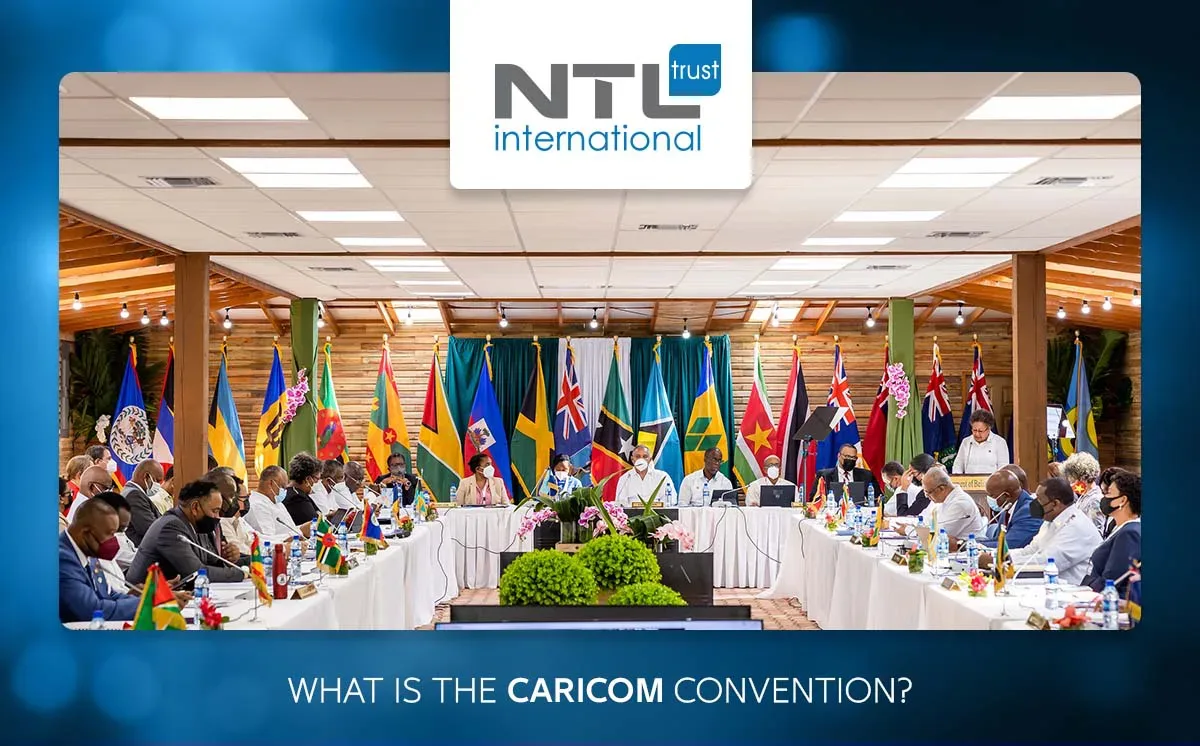
The organization's Secretariat is headquartered in Georgetown, Guyana. CARICOM's highest decision-making body is the Conference of Heads of Government, which convenes at least twice annually and is presided over by a rotating Chairman drawn from among the heads of state or government of the member nations.
CARICOM was designed to serve three core purposes: economic integration through a common market; coordination of foreign and security policy among member states; and functional cooperation in areas including health, education, transportation, and disaster management. Over its five decades of existence, CARICOM has expanded from four founding members to 15 full members and 5 associate members.
CARICOM Member States
The Caribbean Community comprises 15 full member states and 5 associate members. Among the full members, five countries operate government-authorized citizenship by investment programmes.
| Member State | Capital | CBI Programme |
|---|---|---|
| Antigua and Barbuda | St. John's | Yes, active |
| The Bahamas | Nassau | No |
| Barbados | Bridgetown | No |
| Belize | Belmopan | No |
| Dominica | Roseau | Yes, active |
| Grenada | St. George's | Yes, active |
| Guyana | Georgetown | No |
| Haiti | Port-au-Prince | No |
| Jamaica | Kingston | No |
| Montserrat | Brades | No |
| St. Kitts and Nevis | Basseterre | Yes, active |
| Saint Lucia | Castries | Yes, active |
| St. Vincent and the Grenadines | Kingstown | No |
| Suriname | Paramaribo | No |
| Trinidad and Tobago | Port of Spain | No |
The five associate members are Anguilla, Bermuda, British Virgin Islands, Cayman Islands, and Turks and Caicos Islands. Associate members participate in the functional cooperation aspects of CARICOM but do not have full voting rights in the Conference of Heads of Government.
The CARICOM Single Market and Economy (CSME)
The CSME is the economic integration framework established under the Revised Treaty of Chaguaramas (2001). It aims to create a single economic space in which goods, services, capital, and certain categories of labour can move freely among participating member states.
Key components of the CSME include the elimination of tariffs and customs barriers on goods traded between member states; the right of establishment, which allows citizens of one member state to set up businesses in another without discrimination; the free movement of skilled workers, including university graduates, media workers, artists, musicians, and sportspersons; and a coordinated approach to external trade negotiations.
For CBI investors, the CSME framework is particularly significant because it extends the economic value of Caribbean citizenship beyond the borders of the issuing state. A citizen of St. Kitts and Nevis, for example, can establish a commercial enterprise in Barbados or Trinidad and Tobago under CSME provisions, benefiting from regional trade preferences and access to a combined Caribbean market.
Free Movement and Travel Rights
Understanding the precise scope of CARICOM mobility rights is essential for CBI investors. The framework provides specific entitlements, but these are distinct from the broader international travel privileges conferred by a Caribbean passport.
Intra-CARICOM Movement
Under CARICOM treaty provisions, nationals of member states may enter other CARICOM countries without a visa for stays of up to six months. This right applies equally to natural-born citizens and those who acquire citizenship through authorized CBI programmes. Citizens who wish to establish a business or provide professional services in another member state may do so under the right of establishment provisions of the CSME.
International Travel Access
Caribbean passports from CBI countries provide visa-free or visa-on-arrival access to a significant number of destinations worldwide. The exact count varies by country and is subject to change as bilateral agreements evolve. Key access includes Schengen Area travel (90 days within any 180-day period for most Caribbean CBI passports), United Kingdom access (typically six months for tourism, though individual country access may vary; notably, the UK imposed visa requirements on Saint Lucian nationals in early 2026), and access to numerous Commonwealth nations.
It is important to note that Schengen access permits 90 days within a rolling 180-day period, not six continuous months. UK access is for tourism and short-term business visits, not residency. These are travel privileges, not residency rights, and are subject to change based on bilateral relations and regulatory developments.
ECCIRA: The New Regional CBI Regulator
In September 2025, the five Eastern Caribbean nations that operate CBI programmes signed a historic agreement establishing the Eastern Caribbean Citizenship by Investment Regulatory Authority (ECCIRA). This represents the most significant structural reform in the Caribbean CBI sector since the programmes were first established.
What ECCIRA Does
ECCIRA is designed to function as an independent regional regulator for CBI programmes across Antigua and Barbuda, Dominica, Grenada, St. Kitts and Nevis, and Saint Lucia. Its mandate includes setting and enforcing uniform standards for due diligence and applicant vetting, publishing annual compliance reports to enhance transparency, coordinating cross-border information sharing and security screening, licensing and monitoring CBI agents and service providers, and imposing sanctions or revoking licences for non-compliance.
ECCIRA's headquarters will be in Grenada, with regional offices in the other four member states to monitor compliance locally. The agreement contains 92 detailed articles covering all facets of regulation from licensing to reporting.
Regulatory Timeline
By late 2025, four of the five jurisdictions had enacted the ECCIRA agreement into national law. Saint Lucia's ratification was delayed following the general election held on December 1, 2025, which resulted in a temporary pause in the legislative process. As a result, the proposed 30-day mandatory residency requirement for CBI applicants, originally planned for simultaneous implementation across all five states, has been postponed to mid-2026.
This creates a defined transitional window during which applications continue to be processed under the current regulatory framework, without any mandatory physical presence requirement. Applicants who receive approval before the new rules take effect are not expected to be subject to retroactive residency obligations.
Why ECCIRA Matters
The creation of ECCIRA responds directly to sustained pressure from the United States, the United Kingdom, and the European Union for greater transparency, harmonized due diligence, and enhanced security in Caribbean CBI programmes. For investors, unified regulation means stronger programme integrity, greater consistency across jurisdictions, and reduced risk of unilateral policy changes that could affect passport value.
What CARICOM Means for CBI Investors
For individuals who obtain Caribbean citizenship through an authorized CBI programme, CARICOM membership provides a set of concrete, treaty-backed rights:
Freedom of movement: entry to all 15 CARICOM member states for up to six months without a visa, using the Caribbean passport.
Right of establishment: the ability to create, manage, and operate a business in any CSME participating state on the same terms as a local national.
Regional trade benefits: access to the CARICOM common market, including reduced or eliminated tariffs on goods traded between member states, creating opportunities for import-export and manufacturing operations.
Skilled worker mobility: university graduates and certain categories of professionals may apply for CSME skills certificates, enabling them to work across member states without the need for work permits.
E-2 treaty access (Grenada only): Grenada is the only Caribbean CBI country with an E-2 treaty with the United States, providing Grenadian citizens with the ability to apply for US E-2 investor visas.
NTL International is a government-authorized agent for Caribbean citizenship by investment programmes, providing comprehensive support from eligibility assessment and due diligence coordination through application preparation and post-approval guidance.
Current Leadership and Governance
The Conference of Heads of Government is the supreme organ of CARICOM, determining and providing policy direction for the Community. The chairmanship rotates among member states on a semi-annual basis.
As of January 2026, the Chairman of the Conference is the Honourable Dr. Terrance Drew, Prime Minister of St. Kitts and Nevis, serving for the January to June 2026 term. The CARICOM Secretary-General is Dr. Carla Barnett, who oversees the Secretariat in Georgetown, Guyana.
The 50th Regular Meeting of the Conference was held in Basseterre, St. Kitts and Nevis, from February 24 to 27, 2026, under the theme "Beyond Words: Action Today for a Thriving, Sustainable CARICOM." Key deliberations addressed the CARICOM Single Market and Economy, climate change and financing, regional security, transportation, reparations, and foreign and community relations. Special guests included representatives from Saudi Arabia, the UAE, the United States, Afreximbank, and the European Commission.
Frequently Asked Questions
What is CARICOM?
CARICOM (the Caribbean Community) is a regional intergovernmental organization established in 1973 under the Treaty of Chaguaramas. It comprises 15 full member states and 5 associate members across the Caribbean, promoting economic integration, coordinated foreign policy, and functional cooperation among member nations.
What mobility rights do CARICOM citizens have?
Under the CARICOM Single Market and Economy (CSME), nationals of member states can enter other CARICOM countries without a visa for up to six months, establish businesses, and provide services across borders. Certain categories of skilled workers, including university graduates and professionals, have the right to move and work freely within participating CSME states.
What is ECCIRA and how does it affect CBI programmes?
ECCIRA (Eastern Caribbean Citizenship by Investment Regulatory Authority) is the region's first unified regulatory body for CBI programmes. Signed into agreement by five Caribbean CBI states in September 2025 and expected to become operational in 2026, it sets and enforces uniform standards for due diligence, compliance, and programme transparency across Antigua and Barbuda, Dominica, Grenada, St. Kitts and Nevis, and Saint Lucia.
Do CBI investors receive the same CARICOM rights as natural-born citizens?
Yes. Individuals who obtain citizenship through an authorized CBI programme receive the same CARICOM treaty rights as natural-born citizens of that country, including freedom of movement within the Community, the right to establish businesses in other member states, and visa-free or visa-on-arrival access to countries that extend travel privileges to Caribbean passport holders.
Who is the current CARICOM Chairman?
As of January 2026, the Chairman of the Conference of Heads of Government of CARICOM is the Honourable Dr. Terrance Drew, Prime Minister of St. Kitts and Nevis, serving for the January to June 2026 term. The CARICOM Secretary-General is Dr. Carla Barnett.
Related Resources
- Grenada Citizenship by Investment Programme
- St. Kitts and Nevis CBI Programme
- Antigua and Barbuda Citizenship by Investment
- Dominica Citizenship by Investment Programme
- Saint Lucia Citizenship by Investment
- Top Citizenship by Investment Programs 2026
- CBI Due Diligence Process for Second Citizenship 2026
Conclusion
CARICOM remains the institutional bedrock upon which Caribbean economic cooperation and freedom of movement are built. For CBI investors, the Community's treaty framework provides concrete, enforceable rights: visa-free intra-regional travel, the right to establish businesses across member states, and access to a combined Caribbean market under preferential trade terms.
The establishment of ECCIRA in 2025 signals a new era of regulatory maturity for Caribbean CBI programmes. Unified oversight, harmonized due diligence standards, and enhanced transparency serve the interests of both sovereign states and the investors who participate in their programmes. As these reforms take effect through 2026, the value proposition of Caribbean citizenship is being strengthened, not diminished, by greater accountability and international alignment.
NTL will continue to monitor CARICOM developments and ECCIRA implementation, providing updated guidance as the regulatory landscape evolves.
Schedule Your Consultation
Our specialized team is ready to assess your eligibility and guide you through every step of the process.
About NTL International
NTL provides professional guidance and compliance support for global CBI and RBI programs. As a government-authorized agent in select jurisdictions and collaborator with specialized legal experts worldwide, NTL manages the entire application process, ensuring every application meets statutory requirements from initial assessment through final approval, working with local counsel for full compliance.
Our Services Include:
- Eligibility assessment and investment option analysis
- Complete application preparation and submission
- Due diligence coordination and documentation support
- Investment facilitation and government fee processing
- Post-approval support, compliance guidance, and passport renewal
- Diversified CBI-RBI mobility portfolio advisory