St. Kitts and Nevis Biometric Passport Programme: What Citizenship Holders Need to Know
Key Regulatory Takeaways
- St. Kitts and Nevis launched a National Biometric Enrolment and Passport Modernisation Programme on 14 April 2026, jointly run by the Ministry of National Security, Citizenship and Immigration and the CIU.
- All Citizenship by Investment holders, including dependants, must complete biometric enrolment by 31 July 2027 or their existing passport will no longer be valid for international travel.
- Biometric enrolment is now a mandatory step in every new citizenship application submitted from 14 April 2026 onward, booked once the file reaches Approval in Principle.
- Enrolment fees are US$2,500 for the main applicant, US$2,000 for a second adult applicant, and US$1,300 for children under 16, covering both enrolment and the passport upgrade.
- Citizenship status itself is unaffected. This is a travel-document modernisation requirement, not a change to naturalisation.
St. Kitts and Nevis has taken a further step to safeguard the international standing of its passport. On 14 April 2026, the Ministry of National Security, Citizenship and Immigration, working with the St. Kitts and Nevis Citizenship by Investment Unit (CIU), launched the National Biometric Enrolment and Passport Modernisation Programme, aligning the Federation's travel document with the biometric standards already used across the European Union, the United States, and the United Kingdom.
For a jurisdiction that built its reputation as the world's longest-running Citizenship by Investment programme, the move is being framed by the CIU as reinforcing, not complicating, the value of the passport. H.E. Calvin St. Juste, Chairman of the CIU, said at the launch that the modernisation "aligns our passports with those of major nations and strengthens the security of the travel document for every citizen of St. Kitts and Nevis," adding that the programme was built around accessibility, with collection centres opening worldwide, and around data protection, with full government control of biometric information.
The initiative does not alter citizenship status, eligibility, or the underlying legal basis for naturalisation. It is a travel-document upgrade layered on top of an already-granted citizenship.
Biometric passports, those embedding fingerprint, facial, or iris data in a secure chip, have become the baseline expectation at border crossings across the destinations that matter most to Caribbean CBI clients: the Schengen area, the United Kingdom, and North America. A passport issued to an international standard reduces friction at immigration control and lowers the likelihood of secondary screening. By moving proactively to this standard rather than waiting for external pressure, St. Kitts and Nevis is positioning the modernisation as a protective measure for its citizens' mobility, consistent with the programme's long-running emphasis on due diligence and international credibility.
Key Dates and the 31 July 2027 Deadline
The programme has moved quickly since launch. Appointment booking opened on 20 April 2026, and the first wave of enrolment collection centres went live on 1 May 2026. A second phase of collection centres is scheduled to open on 1 June 2026, widening geographic access ahead of the compliance deadline.
The date that matters most for existing Citizenship Programme holders is 31 July 2027. Passports issued through the Citizenship Programme before the 14 April 2026 launch remain valid for international travel during the transition period, but after 31 July 2027, only biometric-enabled passports will be accepted for travel. Citizens who do not complete enrolment by that date keep their citizenship, but their existing passport stops functioning as a valid travel document.
That gives existing citizens just over a year from this article's publication to complete enrolment, and the CIU has structured the rollout in phases rather than opening every collection centre simultaneously, which means capacity at any single location is not unlimited. Citizens who wait until the months immediately before the deadline are likely to compete for appointment slots with the rest of the eligible population attempting to enrol at the same time, a pattern that has been observed in other jurisdictions rolling out similar biometric mandates.
Who Must Enrol: Existing Citizens vs. New Applicants
The requirement splits into two groups. All citizens who obtained citizenship through the St. Kitts and Nevis Citizenship Programme, including all dependants and children, must complete enrolment by 31 July 2027, subject to age-appropriate international standards for younger applicants.
For new applicants, biometric enrolment is now built into the application itself: it is a mandatory component of every citizenship application submitted from 14 April 2026 onward, with the enrolment appointment booked once the application reaches Approval in Principle stage.
On data handling, the CIU's own position is that all biometric data collected, fingerprints, a digital facial image, a digital signature, and, where applicable, an iris scan, is stored in encrypted systems, in compliance with International Civil Aviation Organisation (ICAO) requirements and international data protection standards. Access is described as strictly limited to authorised personnel for identity verification and border security purposes. For clients weighing the requirement against privacy concerns, this is the government's stated framework; it mirrors the data-handling standard used by the biometric passport systems of the EU, US, and UK programmes the initiative is designed to match.
How the Enrolment Process Works
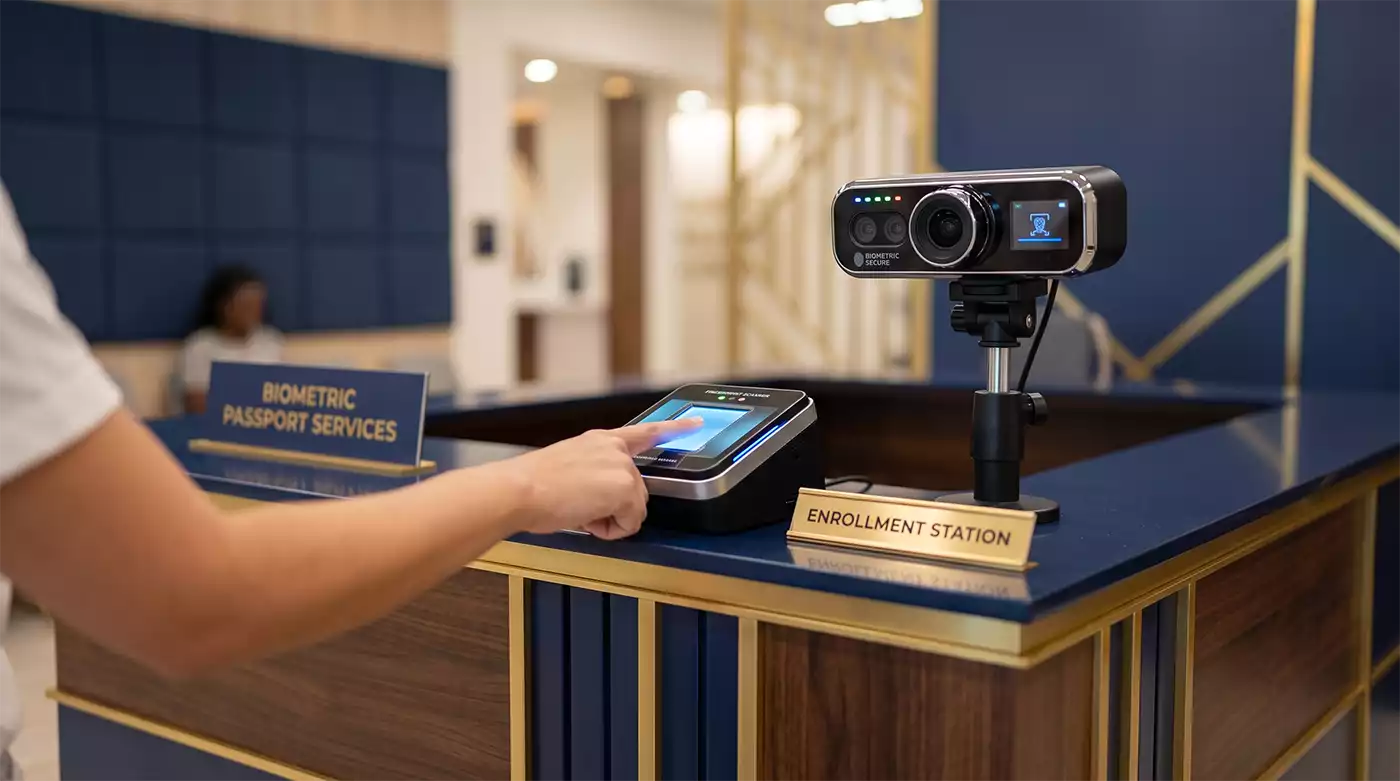
Enrolment is designed to be brief, typically 15 to 30 minutes, but every step must run through the official Government of St. Kitts and Nevis Biometric Enrolment Platform. The CIU is explicit that enrolment through any other platform or third-party provider is strictly prohibited.
Appoint an Authorised Agent
Every existing citizen must appoint an Authorised Agent (AA). The Agent shares a personalised registration link and a unique Authorised Agent Code that links the applicant's profile to them automatically on the official platform.
Register and Book
The applicant creates an account using their Certificate of Registration number, completes the application form, selects the nearest approved collection centre, chooses a date and time, and proceeds to payment. The appointment then moves to Waiting for Agent Confirmation status.
Confirm, Attend and Enrol
The Authorised Agent reviews and confirms the appointment. The applicant attends in person, where fingerprints, a digital facial image, and a digital signature are collected. The passport is presented for identification only; it is not surrendered. Confirmation is sent to both the applicant and the Agent.
Collection centres are currently operating in St. Kitts, Dubai, Hong Kong, Istanbul, Ottawa, Toronto, London, Abu Dhabi, and the Washington, D.C. area, with embassies and high commissions listed on the official portal at the point of booking. Biometric data is captured once and remains valid for the lifetime of the passport: adults do not need to re-enrol at renewal, and there is no separate biometric fee at that stage.
Fees and Payment
Standard fees are all-inclusive, covering both biometric enrolment and the passport upgrade: US$2,500 for the main adult applicant aged 16 and over, US$2,000 for a second adult applicant, and US$1,300 for children under 16. Fees waived for attendees of the CIU's IGS are confirmed through the applicant's Authorised Agent at the time of booking so the waiver applies at payment. Payment itself is processed exclusively through the official Government platform.
Figures above are the standard fees published by the CIU as of this article's verification date. Authorised Agent service fees are separate and are not set by the Government.
For clients budgeting across a family unit, the fee structure is per person rather than per application: a family of four enrolling together, for example, would typically see the main applicant fee, a second adult fee if applicable, and the children's fee applied individually, in addition to any service fee charged by the Authorised Agent handling the booking. Because payment is processed exclusively through the official government platform at the point of booking, clients should not send funds to any party other than the platform itself for the government-set portion of the cost.
What This Means for Investors
For clients who already hold St. Kitts and Nevis citizenship through investment, the practical implication is straightforward but time-sensitive: the current passport keeps working for travel today, but that will stop being true after 31 July 2027 unless biometric enrolment is completed beforehand. Because every existing citizen must work through an appointed Authorised Agent to register and book, this is not a step investors can complete alone through a general government website; the Agent relationship is structurally part of the process.
NTL's advisory team is briefing existing St. Kitts and Nevis clients individually on this requirement, reviewing which dependants on a file need to enrol, and helping clients plan enrolment around travel schedules well ahead of the deadline rather than in the final months of the transition window, when collection centre capacity is likely to tighten.
There is also a practical planning dimension worth flagging for multi-jurisdiction families: because collection centres are currently concentrated in a limited set of cities, and a second phase only opens 1 June 2026, clients based outside those locations should treat enrolment as something to schedule around an already-planned trip, whether that trip is to St. Kitts itself or to one of the international collection points, rather than as a standalone errand. For families holding citizenship across multiple CBI jurisdictions, this is also a reminder to check whether comparable biometric or documentary modernisation requirements are emerging elsewhere in the portfolio, since St. Kitts and Nevis is unlikely to be the last Caribbean programme to align with international travel-document standards.
The 31 July 2027 deadline feels distant today, but the Authorised Agent step means this is not something a client can leave until the last quarter. We are proactively working through our existing St. Kitts and Nevis client base now, confirming which family members still need to enrol, so nobody is caught holding a passport that no longer travels.
St. Kitts and Nevis Biometric Passport Programme FAQ
Does completing biometric enrolment affect my St. Kitts and Nevis citizenship?
No. The National Biometric Enrolment and Passport Modernisation Programme is a passport modernisation initiative only. Citizenship status obtained through the St. Kitts and Nevis Citizenship Programme is not affected in any way.
What happens if I miss the 31 July 2027 enrolment deadline?
Citizenship itself remains intact, but the existing passport will no longer be accepted for international travel after that date. A valid travel document then requires completing biometric enrolment.
Do dependants, including children, need to enrol under the St. Kitts and Nevis Citizenship Programme?
Yes. All dependants who obtained citizenship through the Citizenship Programme must enrol in accordance with age-appropriate international standards, before the 31 July 2027 deadline.
What does St. Kitts and Nevis biometric enrolment cost, and are fees ever waived?
Standard fees are US$2,500 for the main adult applicant, US$2,000 for a second adult applicant, and US$1,300 for children under 16, covering both enrolment and the passport upgrade. Fees are waived for citizens who attended the CIU's IGS; attendance is confirmed with the Authorised Agent at booking so the waiver applies at payment.
Will I need to re-enrol when my St. Kitts and Nevis passport is renewed?
No. Biometric data is captured once and remains valid for the lifetime of the passport. There is no separate biometric fee at renewal, and biometric validation occurs as part of the standard renewal process.
Conclusion
The National Biometric Enrolment and Passport Modernisation Programme is a compliance requirement, not a reason for concern: it brings the St. Kitts and Nevis passport in line with the biometric standards of the world's major travel-document issuers, and it leaves citizenship status untouched. The deadline, however, is fixed, and the Authorised Agent step means the process is not something to defer. Citizens who plan enrolment around upcoming travel, rather than waiting for the window to close, avoid the risk of holding a passport that no longer functions for international travel after 31 July 2027.
Request Your Eligibility Assessment
Handled exclusively by our senior advisory team. All communications are confidential.
About NTL International
NTL provides professional guidance and compliance support for global Citizenship by Investment and Residency by Investment programmes. As a government-authorized agent in select jurisdictions and collaborator with specialized legal experts worldwide, NTL manages the entire application process, ensuring every application meets statutory requirements from initial assessment through final approval, working with local counsel for full compliance.
NTL's compliance practice serves licensed advisors, family offices, and high-net-worth individuals seeking regulatory-grade analysis of cross-border immigration and nationality frameworks. The firm advises only on programmes with established legal foundations and verifiable processing standards.
For St. Kitts and Nevis Citizenship Programme holders affected by the biometric enrolment requirement, NTL's advisory team is reviewing client files individually, confirming which family members require enrolment, and guiding clients through the Authorised Agent process ahead of the 31 July 2027 deadline.