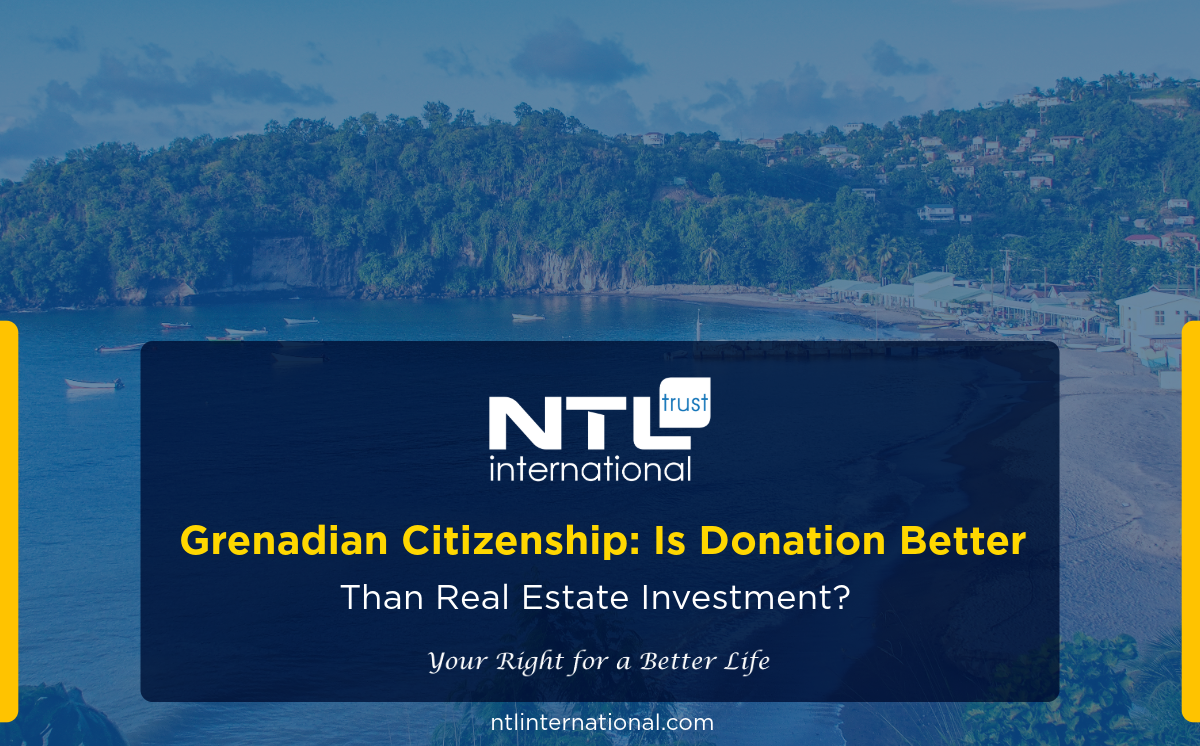
Grenada is one of the most preferred destinations for obtaining citizenship by investment. According to the 2024 NTL report, based on various factors, Grenada’s citizenship ranked first among the top 10 countries offering citizenship by investment programs. Read more
Grenadian citizenship can be obtained through two main options:
- Donation to the National Transformation Fund (NTF).
- Investment in a government-approved project.
This article will explore the differences between these two options according to the latest fees and costs.
Obtaining Grenadian Citizenship by Donation:
Donation to the National Transformation Fund (NTF):
– The main applicant and up to 3 family members: $235,000.
Obtaining Grenadian Citizenship by Real Estate Investment:
Investment in a Government-Approved Project:
– $350,000 by investment in a freehold property (private real estate).
– $270,000 by shared ownership in the tourism sector exclusively.
– Plus, a government contribution fee of $50,000 (for the main applicant and 3 additional family members).
Additional Costs for Obtaining Grenadian Citizenship:
– Adding children costs $25,000 per child.
– Parents or grandparents under 55: $50,000 and $25,000.
– Children over 18 years old: $50,000 per individual.
– Siblings between 18 and 30 years old: $75,000 per individual.
Comprehensive Comparison of Methods to Obtain Grenadian Citizenship:
Cost:
If you have a family of four, the first option (donation) will be less expensive at $235,000 compared to the second option at $320,000.
Flexibility in Adding Family Members:
Both options offer the same additional fees for dependent family members.
Timeframe and Procedures:
After deciding to invest in real estate, you will need time to choose a project from the government-licensed and approved projects. This is where NTL can assist you in selecting the property that suits your needs.
Investment and Returns:
The donation option, being non-refundable, does not yield any profits. However, with the investment option, you can sell the property to someone else seeking Grenadian citizenship after the holding period, in addition to earning returns ranging between 3% to 5% after the project becomes operational.
Some might initially believe that the difference between the two methods is significant in cost. However, when excluding the property’s value, the government and administrative expenses for both methods become comparable. Choosing the appropriate method for obtaining citizenship in Grenada depends on the personal and financial goals of the investor. If the goal is to acquire citizenship at a relatively lower cost, then donating to the National Transformation Fund is the optimal choice. On the other hand, if the investor is interested in investing in future projects with the potential for financial returns, the second option may be more suitable.
Mr Imad Elbitar’s point of view:
Before the recent agreement, there was a clear disparity in prices between donations and real estate investments. However, today, the two options have become quite comparable. From the perspective of an international consultant in second citizenship programs, real estate investment is considered the better choice, provided that the required amount is available and there are no other obstacles.
In conclusion, it is always important to consult with citizenship investment experts before deciding to ensure a clear understanding of all the legal and financial aspects related to each method.
Nauru Is Now the Republic of Naoero: What It Means for the Citizenship Program
The Republic of Nauru has officially adopted the name Republic of Naoero. Citizenship Certificates now bear the new name; passports remain issued as Nauru during the transition.

EU Caribbean CBI Phase-Out by 2028: What the Visa Suspension Mechanism Means for Investors
The EU’s revised Visa Suspension Mechanism now treats CBI programme operation itself as suspension grounds. Antigua & Barbuda, Dominica, Grenada, St Kitts & Nevis, and Saint Lucia have reportedly been asked to phase out by 1 June 2028.

UAE Tourist Identity: Instant Digital Bank Account Launch
The Central Bank of the UAE, ICP, and ADCB have launched a digital identity-linked banking service allowing non-resident visitors to open an account and receive a debit card within minutes of arrival.

Best Residency by Investment Programs 2026
Compare 10 residency by investment programs in 2026: Greece, UAE, Portugal, Malta, Hungary, Germany, Latvia, Cyprus, USA EB-5, Türkiye. Analysis by NTL International.

EU Entry/Exit System and UK ETA: New 2026 Border Requirements for RBI Applicants
New EU and UK border systems mean RBI applicants traveling for property viewings, biometric appointments, or permit collection should plan for longer first-entry processing and confirm UK ETA status before departure.